You are using an out of date browser. It may not display this or other websites correctly.
You should upgrade or use an alternative browser.
You should upgrade or use an alternative browser.
Blitz Nozzles
- Thread starter jlab
- Start date

I just looked. TFT make 3 different inlet sizes. 2.5, 3, 3.15. All with 2.5 outlets. Pretty much no matter what you do your limited to 500 gpms. Because thats what its designed for. The typical goto is 2.5. We used 3" with 2.5 couplings just for friction loss reasons. Our Elkhart RAN was also preconnected to 200' of 3 inch. I would assume FDNY would just use 2.5 hose straight from the bed or hirise packs as that gives you the best options on lengths, since they use dead loads, not preconnects.I believe they come standard with 2.5 couplings. Most 3" hose has 2.5" couplings. I'm not sure what the FDNY's 3.5" hose coupling sizes are but they're also probably 2.5" couplings.

- Joined
- Sep 7, 2020
- Messages
- 2,917
A 2.5 inch hose can move 500 GPM at 55psi friction loss per 100 feet.I just looked. TFT make 3 different inlet sizes. 2.5, 3, 3.15. All with 2.5 outlets. Pretty much no matter what you do your limited to 500 gpms. Because thats what its designed for. The typical goto is 2.5. We used 3" with 2.5 couplings just for friction loss reasons. Our Elkhart RAN was also preconnected to 200' of 3 inch. I would assume FDNY would just use 2.5 hose straight from the bed or hirise packs as that gives you the best options on lengths, since they use dead loads, not preconnects.
I think the 3 inch we used was closer to 40 per 100. I dont remember off hand. I want to say it was like 37 per 100. I'd have to look and see if I still have the friction loss cards we had.A 2.5 inch hose can move 500 GPM at 55psi friction loss per 100 feet.

"The inlet and the outlet of the Blitzfire are both equipped with 2 ½” threads. There is one 2 ½” supply inlet which should be supplied with only one 2 ½” hoseline."
Attachments


- Joined
- Feb 7, 2012
- Messages
- 470
FDNY 3 1/2" hose has 3" butts. Never really understood the logic of losing 1/2" diameter every 50 ft. and the associated friction loss.I believe they come standard with 2.5 couplings. Most 3" hose has 2.5" couplings. I'm not sure what the FDNY's 3.5" hose coupling sizes are but they're also probably 2.5" couplings.
Is there a comparison to be made for the volume of water and effectiveness delivered by the blitz nozzle vs multiversal vs deck pipe vs tower ladder?Blitz nozzles are made with a 3 inch intake. In the FDNY, where they are used, are they fed with a 2 1/2 line or do companies carry 3 inch hose specifically for use with a Blitz nozzle or do they ise a 3 1/2 inch line to supply the nozzle ?
- Joined
- Sep 7, 2020
- Messages
- 2,917
The Blitzfire is limited to 500 GPM with max input pressure of 175 psi. The multiversal flows 400-1000 GPM depending on tip size under normal conditions. Deck pipes can flow 400-to about 2000 GPM depending on tip size and pressure supplied. 2000 GPM achieved using a 2-1/2” tip with 116 psi tip pressure. Ladder pipes use a 1-1/2” tip and flow 660 GPM when properly supplied. Tower Ladders have 1-1/2” and 2” tips. The 2” tip on a properly supplied Tower ladder produces 1200 GPM. The reach of a tower ladder stream with a nicely matched tip and pressure combination can be double that of a blitzfire. The portable monitors (blitz and Multiversal ) are limited to lower tip pressures to prevent loss of control/stability. The piped deck guns and tower ladder monitors can handle higher pressures. They are all tools in the toolbox.Is there a comparison to be made for the volume of water and effectiveness delivered by the blitz nozzle vs multiversal vs deck pipe vs tower ladder?
Last edited:
Just 1 thing to add is friction loss and pump pressures. The typical 2.5s can barely handle a blitzfire or ran. With FDNYs friction loss of 55 psi per 100 feet, at 200 feet your at 110 psi. Fl. Add in the nozzle, say stack tip which is 50 psi, and your already at 160 psi. Pp. And over most pumps maximum rated capacity.Use a fog and your at 210 psi. Over the pump capacity, over the 175 max for the bf and in the downhill curve of pump performance. So there are trade offs and its 1 reason we went to 3 inch to supply our RAN nozzle. 1 person can still pick it and move it easily, compared to a multiversal, which gives it great maneuverability. Its a little awkward but it can be done. On the other hand, it takes a small army to setup or move a multiversal. And probably 2x the amount of time.

- Joined
- Apr 1, 2007
- Messages
- 4,521
Seems to me that comparing the Blitzfire to a multiversal is a little bit like comparing a sledge hammer to a halligan tool. They are for different purposes. Should you know the benefits and drawbacks of both? Absolutely, so you can make the proper choice in the situation facing you. RCL makes a great point about the maneuverability of the blitzfire. And it can be set to oscillate by itself . . . another potential benefit in a situation where you can't afford to have firefighters stay with it.
- Joined
- Feb 27, 2010
- Messages
- 1,372
My department runs as standard on all tanker pumpers, a preconnected Blitzfire We service a large rural area with limited resources arriving second due and minimum manning so if we have a significant volume of fire showing it will be a Blitzfire or deckgun applied for a quick knockdown until the troops can gather. Very effective.
- Joined
- Jan 15, 2025
- Messages
- 349
All portable large Caliber Stream device should be tied or tethered down, the greater the discharge = GPM, the more important securing the device with rope or straps is to prevent the device from becoming unstable and going out of control. If at all possible, keep the supply hoseline/s straight as possible for a distance behind the connection points, this also adds in keep the device stable. I saw a few times when portable Large Caliber stream devices became unstable and caused Firefighter Injuries. Use the largest supply hose you can and use the right size discharge tip you can. If the device is semi mounted in any way to an apparatus, you have an advance in stability and speed of application. FDNY once had what was called "Kelsey Mounts" on the bed or side of aerial ladders so portable Stangs or Multiversals could be secured in place on the aerial ladder apparatus, taking advantage of the fact that the aerial ladder apparatus was already Infront of the fire building, as it should be.
I do indeed wish we had Blitzfire deice during the FDNY "War Years" Captain Bob Rainey FDNY Engine 26 retired
I do indeed wish we had Blitzfire deice during the FDNY "War Years" Captain Bob Rainey FDNY Engine 26 retired

- Joined
- Mar 3, 2007
- Messages
- 1,693
I've seen photos of L-42 with a Stang mounted to the roof of the phonebooth on their rearmount. Don't know anyone else, but I'm sure they were aroundAll portable large Caliber Stream device should be tied or tethered down, the greater the discharge = GPM, the more important securing the device with rope or straps is to prevent the device from becoming unstable and going out of control. If at all possible, keep the supply hoseline/s straight as possible for a distance behind the connection points, this also adds in keep the device stable. I saw a few times when portable Large Caliber stream devices became unstable and caused Firefighter Injuries. Use the largest supply hose you can and use the right size discharge tip you can. If the device is semi mounted in any way to an apparatus, you have an advance in stability and speed of application. FDNY once had what was called "Kelsey Mounts" on the bed or side of aerial ladders so portable Stangs or Multiversals could be secured in place on the aerial ladder apparatus, taking advantage of the fact that the aerial ladder apparatus was already Infront of the fire building, as it should be.
I do indeed wish we had Blitzfire deice during the FDNY "War Years" Captain Bob Rainey FDNY Engine 26 retired
- Joined
- Jan 15, 2025
- Messages
- 349
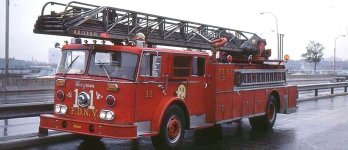
I covered as a Lieutenant in the South Bronx in Ladder 42 in the mid 1980's. and as you said a Stang was mounted on the roof of the of their Seagrave rear mounted aerial. I have seen both Multiversals and Stang large caliber stream devices semi-attached to the roof of both aerial ladders and Tower Ladders. I have even seen portable Ladder pipes rigged up on the side of bedded aerial ladders so they can be aimed without placing them on any ladder at all. Captain Bob Rainey FDNY Engine 26 retired

- Joined
- Apr 23, 2018
- Messages
- 1,242
I've seen photos of L-42 with a Stang mounted to the roof of the phonebooth on their rearmount. Don't know anyone else, but I'm sure they were around
Attachments
- Joined
- Apr 23, 2018
- Messages
- 1,242
OH... THE HUMANITY...!
- Joined
- Apr 23, 2018
- Messages
- 1,242
or you can use this little baby...My department runs as standard on all tanker pumpers, a preconnected Blitzfire We service a large rural area with limited resources arriving second due and minimum manning so if we have a significant volume of fire showing it will be a Blitzfire or deckgun applied for a quick knockdown until the troops can gather. Very effective.